There are now 1,100 marchers who are 20 kilometers from Caranavi, next stop on their trek towards the city of La Paz. Today, after seven hours of walking alongside deep ravines, typical scenery in the Yungas region, the Eighth Indigenous March advanced 30 kilometers until the village of Carrasco. This morning deputy Pedro Nuni of the Mojeño peoples warned that the Plurinational Legislative Assembly would discuss a law which seeks the “temporary suspension” of the construction of the “second section” of the highway between Villa Tunari and San Ignacio de Moxos. “It´s offensive don’t you think? Because there is no law that approves the first or third sections. There is a law on the protocol to ask for loans, the way to get funding. This is one project and it is called the “Villa Tunari and San Ignacio de Moxos highway” and nothing else.
“It is offensive to approve a law to suspend the second section. I think that even the Bolivian people don´t believe it because in reality they (the government) want to make people inside the TIPNIS believe that with this the problem will be solved. There needs to be a law that annuls the process of the highway project, that annuls the laws that back this project and to start again from scratch. The procedure needs to be started again complying with national legislation as well as international treaties and conventions”, said Fernando Vargas Mosúa, President of the Subcentral communities of the Isiboro Sécure Indigenous Territory and National Park (TIPNIS).
“Solidarity campaign to support the brothers marching from the TIPNIS. Your donation is very very important! Don´t ignore us!” is what was written on a sign in the Simón Bolívar square in Caranavi. All day local residents spent the day trying to persuade the population of the need to receive the Eighth March well to demonstrate that Caranavi shows its solidarity. “We will receive the indigenous marchers with open arms. When they get to La Paz Evo will have a big problem”, said a gentlemen who has recently turned on the government of the Movement Towards Socialism (MAS). Until recently he was one of the three million who voted to re-elect Morales as President in 2009.
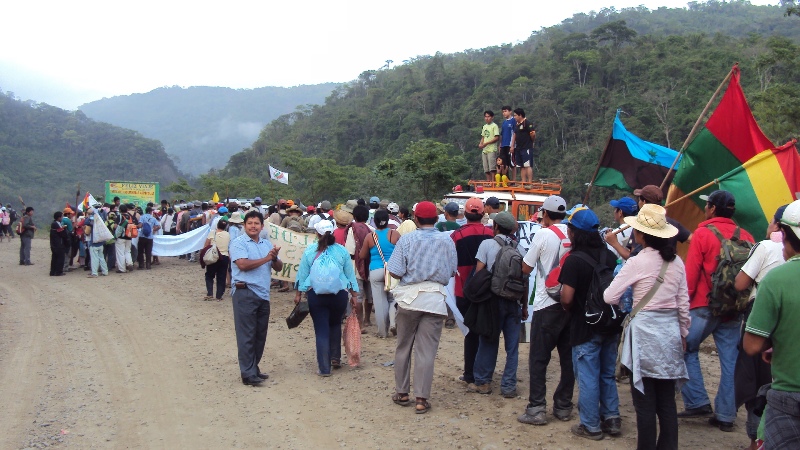
The march advanced until Carrasco with the sound of drums and chanting in support of the Eighth Indigenous March. The marchers had their regional flags, the Bolivian flag, the Wiphala (indigenous flag), hats, rucksacks; and bows, arrows and whistles in the hands of the Indigenous Guard who were worried about passing vehicles hitting any marchers on the long road. There are many new faces on the march.
“15 people arrived from the TIPNIS yesterday, 20 from the Multi-ethnic Indigenous Territory (TIM), many from the Chiman Great Council and from CPILAP (La Paz Indigenous Peoples Central). The grassroots are joining the march. This is the fundamental thing we need to give greater strength to the march, to lift our spirits of each and every marcher who is already here”, said Vargas who is leading the march with a bandaged chest because he has a fissure in his chest after the government repression on the 25 September in Yucumo, Beni region.
“After the big kicking I got on Sunday (25 September) I have an injured rib. I have to walk with a bandage to resist the pain, I hope it heals more while we are walking”, said the President of the communities of the TIPNIS.
A counter march would be better than a blockade of the indigenous march like the one the Confederation of Intercultural Communities of Bolivia (CSCIB) and the national police held last week in Yucumo. But the indigenous marchers are still worried about the march announced by the Confederation of Bolivian Campesino Workers Unions (CSUTCB) from Oruro to La Paz on 12 October in support of President Evo Morales and against the march organised by the Confederation of Bolivian Indigenous Peoples (CIDOB) and the National Council of Ayllus and Markas of Qullasuyu (CONAMAQ) that they say is “politicized”.
“The actions of this government are a shame; they do not know what else to do. This government damaged us on Sunday (25 September) and they are still pushing for other social movements to go against the Eighth Indigenous March. The only thing they will like that is politically undermining themselves as a government, the one that is promoting clashes between us. They should not condemn the march or the right or anyone because the actor creating this situation is the government, so that they can present themselves as victims”, claimed Vargas Mosúa.
The indigenous march was repressed 12 days ago by the Morales government. But still nobody inside the Morales government has take responsibility for giving the order to beat, tear gas and detain the marchers amongst whom children, elderly men and women were present. “We are starting legal action to find out why they cruelly attacked us in Yucumo. We know the judicial process is unequal. We know the justice system is manipulated and dominated by the Executive branch”, said Vargas.
“Wait! We want to rest! Each ten kilometers a lot of the marchers demand the rest stop a few minutes to air the blisters and corns of the day. They sit on the side of the ravine´s where passing trucks, lorries and coaches cover them in so much dust they can´t recognize who is sitting next to them. On the positive side nearly all of the drivers wave and honk their horns.
One kilometer from Carrasco and the marchers feet hardly move and they can´t distinguish between hunger and thirst. Like an apparition an indigenous lady appears in the road with a cart.
She looks at the long line of people and asks in a low voice “Are these the marchers?”
When they tell her it is the shouts “They are so brave!”
From the thirsty march they ask her what she sells.
- Drinks
Once they prove she is real a group of marchers surround her with their containers ready to quench their thirst. In the beginning the lady charges 1 Boliviano for each drink (nobody asks her what flavor they are). When she realizes how successful her business is she increases the price to 1 Boliviano fifty cents.
“They have told us delegations are coming from La Paz with food. We hope they can cover the lack of food. Even though sometimes food is scarce we still have enough to eat at least once a day. I don´t think anyone will die from hunger”, says Vargas who is one of the spokespersons of the march.
“We want to make clear that we never opposed the building of a highway to link the Beni and Cochabamba regions. But we do not want it to go through the TIPNIS. This is why we are marching because the government is stubborn and wants to build this highway that would cut the TIPNIS in two”, said Vargas. The demand to respect this Protected Area is the first on the list of the Eighth Indigenous March. The marchers hope to resolve all these demands with the President in the Presidential Palace.
The indigenous marchers put up their tents between the tens of houses in the village of Carrasco. The owner of one of the shops gave each of the marchers as they passed her shop/home a Popsicle and a winning smile. The children got the most. Another resident got big bucket of something to drink ready to give to the marchers who have just arrived with their thirsty faces covered in dust. Early tomorrow morning the march continues and will arrive in Carnavi at midday. From there it is only 160 kilometers to the city of La Paz.
(Communication Commission of the Eighth Indigenous March)
Marcha Indígena: “Debe haber una ley que anule todo el proyecto carretero”
Ya son 1100 las y los marchistas que se encuentran a 20 kilómetros de Caranavi, próxima parada en su caminata hacia la ciudad de La Paz. Hoy, la Octava Marcha Indígena avanzó 30 kilómetros hasta la comunidad Carrasco, luego de siete horas sobre una senda de piedras afiladas y barrancos profundos, característicos del paisaje de los Yungas paceños. Esta mañana, el legislador mojeño Pedro Nuni advirtió que en la Asamblea Legislativa Plurinacional se trataría un proyecto de ley, el cual –según el orden del día- procurará la “suspensión temporal” de la construcción del “tramo dos” de la carretera Villa Tunari-San Ignacio de Moxos. “Es una mamada ¿no? Porque aquí no hay una ley que apruebe el tramo uno ni el tramo dos ni el tramo tres. Aquí hay una ley sobre el protocolo para suscribir préstamos, de modo de obtener financiamiento. El proyecto es uno y se llama ‘Carretera Villa Tunari-San Ignacio de Moxos’ y no hay más.
Si dicen que se va a sacar una ley corta para suspender el tramo dos es una mamada. Eso creo que ni el propio pueblo boliviano lo cree, porque en realidad están (el Gobierno) queriendo hacer creer al TIPNIS que con esto se soluciona el problema. Aquí debe haber una ley que anule todo el proceso del proyecto carretero, que anule las leyes que han dado fe a este proyecto y así empezar de nuevo, volver a foja cero. Y que se inicie nuevamente el procedimiento, cumpliendo los principios nacionales, así como los tratados y convenios internacionales”, dijo Fernando Vargas Mosúa, presidente de la Subcentral de comunidades del Territorio Indígena Parque Nacional Isiboro Sécure (TIPNIS).
“Campaña de solidaridad en favor de los hermanos marchistas del TIPNIS ¡Tu aporte es muy muy importante! ¡No seas indiferente!”, según un cartel legible en la plaza Simón Bolívar, de Caranavi. Durante todo el día, varios vecinos se dedicaron a hacer perifoneo para persuadir a la población de lo conveniente que sería recibir a la octava marcha con harto cariño, para demostrar al mundo que este pueblo es solidario. “Vamos a recibir a los indígenas con los brazos abiertos. Cuando lleguen a La Paz, el Evo está jodido”, dijo un señor que recientemente se volvió reacio al gobierno del Movimiento Al Socialismo (MAS), hace tan poco que está entre los tres millones de electores que ofrendaron su voto a Morales en 2009 para tenerlo nuevamente de presidente.
La marcha avanzó hasta Carrasco entre ritmos de la tamborita y vivas a la Octava Marcha Indígena. Las y los marchistas iban con banderas de sus regionales, de Bolivia, algunas wiphalas, gorras, mochilas; más los arcos, flechas y silbatos de los guardias indígenas, preocupados de que ninguna movilidad arrollara a algún hermano en el camino estrecho. Hay muchas caras nuevas en la movilización.
“Del TIPNIS han llegado anteayer 15 personas; del TIM (Territorio Indígena Multiétnico) 20 personas, del Gran Consejo Chimán otra gran cantidad, lo mismo los hermanos de la CPILAP (Central de Pueblos Indígenas de La Paz). Se están plegando las bases a la marcha. Ese es un elemento fundamental para dar mayor fortaleza a toda la marcha, para inyectar de ánimos a cada uno de los marchistas que estamos ahora”, dijo Vargas, quien iba al frente de la movilización, con el pecho vendado porque tiene una costilla fisurada luego de la represión gubernamental del 25 de septiembre en Yucumo, Beni.
“Después de la tremenda pateadura que me dieron el domingo (25 de septiembre) tengo una costilla lastimada. Tengo que andar vendado para poder resistir el dolor, esperemos que mientras vamos caminando pueda recuperarme cada vez más”, confió el presidente de las comunidades del TIPNIS.
Una contramarcha sería preferible a un bloqueo a la octava marcha, como el realizado por la Confederación Sindical de Comunidades Interculturales de Bolivia (CSCIB) y la Policía Nacional días atrás en Yucumo. No obstante, preocupa un poco a los indígenas la caminata anunciada por la Confederación Sindical Única de Trabajadores Campesinos de Bolivia (CSUTCB) para llegar desde Oruro hasta la sede de Gobierno el próximo 12 de octubre, en apoyo del presidente Evo Morales y en contra de la movilización de la Confederación de Pueblos Indígenas de Bolivia (CIDOB) y del Consejo Nacional de Ayllus y Markas del Qullasuyu (CONAMAQ), a la que acusan de estar “politizada”.
“Es una pena el accionar de este gobierno, que no sabe qué más hacer. Este Gobierno nos sacó la mierda el domingo (25 de septiembre) y sigue todavía impulsando a otros grupos sociales contra la Octava Marcha Indígena. Así, lo único que consigue es el deterioro político del mismo Gobierno, el que está promoviendo enfrentamientos. Que mañana pues no acuse a la marcha, que no acuse a la derecha ni a nadie, porque quien está preparando todo este escenario es el Gobierno, para después hacerse la víctima”, consideró Vargas Mosúa.
La marcha indígena fue reprimida hace 12 días por el gobierno de Morales. Pero todavía nadie dentro del gobierno de Morales se responsabilizó de dar la orden de apalear, gasificar y detener a los marchistas, niños, mujeres ancianos y hombres, entre ellos. “Ya estamos iniciando acciones legales para que se esclarezca por qué nos agredieron cruelmente en Yucumo. Sabemos que este es un proceso judicial desigual. Tenemos que entender que el Órgano Judicial está direccionado y manejado por el Órgano Ejecutivo”, dijo el líder del pueblo Mojeño.
“¡Alto! ¡Queremos descansar!” Cada decena de kilómetros, gran parte de los marchistas exigía al resto detenerse algunos minutos para airear las ampollas y los callos de la jornada. Se sentaban al borde del barranco, donde los cubría el polvo de los camiones, flotas y camionetas que pasaban, con tanto polvo que ya no podían reconocer a quién tenían al lado. Lo positivo es que casi todos los transportistas sacaban los brazos para saludarlos o hacían estrepitar sus bocinas.
Cuando estaban a un kilómetro de Carrasco, los pies lastimados ya se movían por inercia, las y los indígenas ya no podían distinguir entre la sed y el hambre. Como si fuera un espejismo, una cholita se apareció en el camino arrastrando una carretilla con dos conservadoras.
Miró a la fila llegar y preguntó por lo bajo: “¿Estos son los marchistas?”.
Cuando le dijeron que sí, repuso: “¡Son tan valientes!”.
Desde la marcha sedienta la preguntaron qué vendía.
-Refresquito.
Al comprobar que la señora era real, un enjambre de marchistas la rodeo dispuesto a secar sus contenedores de un sorbo. Al principio, la señora cobraba la bolsita de refresco (nadie preguntó por el sabor) a un boliviano. Cuando se percató del éxito de su empresa, subió el precio a un boliviano con cincuenta centavos.
“Nos han informado que vienen delegaciones de La Paz con alimentos. Esperemos que se puedan solucionar los vacíos que hay en este rubro. Aunque el alimento a veces es escaso, todavía comemos por lo menos una vez al día y creo que no nos morimos de hambre”, dijo Vargas, uno de los voceros de la marcha.
“Queremos decir que jamás nos hemos opuesto a la construcción de una carretera que vincule a Beni y Cochabamba. Queremos la carretera, pero no queremos que pase por el TIPNIS. Por eso estamos marchando, porque el Gobierno se empecinó en realizar esta carretera, partiendo en dos al TIPNIS”, dijo Vargas. El pedido de que se respete a esta área protegida es el primero de la lista de demandas de la octava marcha. Las y los marchistas esperan resolver todos los puntos junto con el Presidente en el Palacio Quemado.
En Carrasco, las y los indígenas armaron sus tiendas donde hubiera espacio, entre la decena de casas de la comunidad. La casera de una de las dos ventas de la población llamaba a cada marchista que pasaba frente a su negocio/casa para regalarle un chupete relleno de chicle junto con su mejor sonrisa. Niñas y niños eran los más beneficiados. Otra vecina se puso a preparar grandes baldes de refresco, en vista de las caras secas polvorientas de los recién llegados. Mañana al amanecer deberían seguir su caminata hasta Caranavi, donde entrarían al mediodía. Desde allí hasta la ciudad de La Paz solo les faltarán 160 kilómetros.
(Comisión de Comunicación de la Octava Marcha Indígena)